
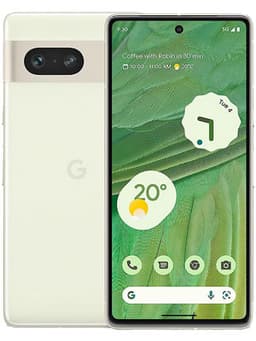
Google Pixel 7 price in Pakistan
Google Pixel 7 price in Pakistan is Rs. 144,999 (last updated 15 Oct 2026). See all Google phones.
The Google Pixel 7 is a camera and software phone first. Its 50 MP main camera delivers natural colour, wide dynamic range and quick night shots, and Google's AI tools, from call screening to photo unblurring, save real time every day. The trade-off is hardware that is good rather than leading: the Tensor G2 handles daily use and demanding games well, but it is not a performance champion.
Who it's for
- Point-and-shoot photographers: excellent photos come without touching any settings, and software zoom stays sharp up to 8x.
- Busy professionals: call screening, Direct My Call and highly accurate voice typing cut routine phone admin.
- Mid-range upgraders: clean, bloat-free software in a sturdy IP68 body makes it a simple, durable step up.
Where it falls short
The 90Hz screen feels less fluid than many rivals, and its bezels are thick. Battery life divides opinion: some heavy days end with charge to spare, others need an evening top-up, and 20W charging slows sharply after 80%. The ultrawide struggles in low light, face unlock fails in the dark, and early software showed bugs.
Worth comparing
The Xiaomi Redmi Note 15 and Infinix Hot 60 Pro cost far less and bring bigger batteries, smoother 120Hz or 144Hz screens and faster charging, which suits heavy users. Both, however, are 4G-only phones on Helio chips with only IP64 splash protection, and neither comes close on photo processing or AI features. Pick a rival for endurance and smoothness; pick the Pixel when photos and software matter most.
| Network | Technology | GSM / CDMA / HSPA / EVDO / LTE / 5G |
|---|
| Launch | Announced | 2022, October 06 |
|---|---|---|
| Status | Available. Released 2022, October 13 |
| Body | Dimensions | 155.6 x 73.2 x 8.7 mm |
|---|---|---|
| Weight | 197 g | |
| Build | Glass front (Gorilla Glass Victus), glass back (Gorilla Glass Victus), aluminum frame | |
| SIM | Nano-SIM + eSIM |
| Display | Type | AMOLED, 90Hz, HDR10+, 1000 nits (HBM), 1400 nits (peak) |
|---|---|---|
| Size | 6.3 inches (~84.9% screen-to-body ratio) | |
| Resolution | 1080 x 2400 pixels, 20:9 ratio (~416 ppi density) | |
| Protection | Corning Gorilla Glass Victus |
| Platform | OS | Android 13, upgradable to Android 16, up to 7 major Android upgrades |
|---|---|---|
| Chipset | Google Tensor G2 (5 nm) | |
| CPU | Octa-core (2x2.85 GHz Cortex-X1 & 2x2.35 GHz Cortex-A78 & 4x1.80 GHz Cortex-A55) | |
| GPU | Mali-G710 MP7 |
| Memory | Internal | 128GB 8GB RAM, 256GB 8GB RAM |
|---|---|---|
| Card Slot | No |
| Main Camera | Modules | 50 MP, f/1.9, 25mm (wide), 1/1.31", 1.2µm, dual pixel PDAF, OIS 12 MP, f/2.2, 114˚ (ultrawide), 1/2.9", 1.25µm |
|---|---|---|
| Features | Laser AF, Dual-LED flash, Pixel Shift, Auto-HDR, panorama | |
| Video | 4K@30/60fps, 1080p@30/60/120/240fps; gyro-EIS, OIS, 10-bit HDR |
| Selfie Camera | Modules | 10.8 MP, f/2.2, 21mm (ultrawide), 1/3.1", 1.22µm |
|---|---|---|
| Features | HDR, panorama | |
| Video | 4K@30/60fps, 1080p@30/60fps |
| Sound | Loudspeaker | Yes, with stereo speakers |
|---|---|---|
| 3.5mm Jack | No |
| Comms | WLAN | Wi-Fi 802.11 a/b/g/n/ac/6e, tri-band, Wi-Fi Direct |
|---|---|---|
| Bluetooth | 5.2, A2DP, LE, aptX HD | |
| GPS | GPS (L1+L5), GLONASS (G1), BDS (B1I+B1c+B2a), GALILEO (E1+E5a), QZSS (L1+L5) | |
| NFC | Yes | |
| Radio | No | |
| USB | USB Type-C 3.2 |
| Features | Sensors | Fingerprint (under display, optical), accelerometer, gyro, proximity, compass, barometer |
|---|
| Battery | Type | Li-Ion 4355 mAh |
|---|---|---|
| Charging | 20W wired, PD3.0, 50% in 30 min 20W wireless Reverse wireless |
| Misc | Colors | Obsidian, Lemongrass, Snow |
|---|---|---|
| Models | GVU6C, GQML3, GO3Z5 |
Similar Price Range




Top Trending Mobiles
More from Google
See more



Other Google models
- Google Pixel 5a 5GRs. 51,999
- Google Pixel 6Rs. 115,999
- Google Pixel 6 ProRs. 114,999
- Google Pixel 6aRs. 94,999
- Google Pixel 7This phone
- Google Pixel 7 ProRs. 209,999
- Google Pixel 7aRs. 137,999
- Google Pixel 8Rs. 163,999
- Google Pixel 8 ProRs. 253,999
Google Pixel 7: Buyer's Guide
Is It Value for Money?
Only at the right price, and mainly for camera-first buyers. The Pixel 7 still takes some of the most reliable point-and-shoot photos at its level, runs clean software with useful AI tools, and has a sturdy IP68 body with Gorilla Glass Victus on both sides.
Against that, it launched in 2022. Its Android version updates ended with Android 16, and Google's five-year update window means security updates run only until about October 2027, so its software life is now limited. The 90Hz screen, 20W charging and average-to-good battery life also trail newer phones.
Verdict: worth it for photography lovers if it costs clearly less than newer rivals; buyers who keep a phone for many years should choose a newer model with more updates ahead.
How Is the Display?
It has a flat 6.3-inch Full HD+ AMOLED panel with HDR10+ and Gorilla Glass Victus, rated at 1000 nits in high-brightness mode and 1400 nits peak, so it stays bright outdoors. Colours are accurate, and HDR10+ works well in streaming apps. At this size, Full HD looks sharp enough.
The weak points are smoothness and looks. It refreshes at only 90Hz, so scrolling feels less fluid than on the many phones with 120Hz or faster screens. The bezels are noticeably thick, with a slightly bigger chin at the bottom, and the edge where the flat glass meets the frame can feel a little sharp when swiping.
How Is the Performance?
The Tensor G2 is Google's own chip, built more for AI tasks than for raw speed. Apps open quickly and the phone feels smooth in daily use, with few moments of waiting.
Accounts of its power differ. One test put its CPU close to Samsung's flagship of the time in Geekbench, with the GPU only slightly behind; others compared it to older or weaker Snapdragon and Apple chips. In practice, heavy games such as Genshin Impact run at high settings, and it heats up and slows under long sessions much like its rivals, but dedicated gaming phones still do better.
Where Tensor G2 shines is on-device AI: voice typing, call noise removal, text extraction and photo unblurring are fast and accurate. One small irritation is that switching between camera lenses is not as smooth as the rest of the system.
How Is the Camera?
The rear has a 50 MP main camera with optical stabilisation and a 12 MP ultrawide; the front has a 10.8 MP ultrawide selfie camera. Photo processing is the star: daylight shots have wide dynamic range, strong detail and natural depth, portraits look excellent, and night shots are captured quickly, so they come out less blurry. Opinions differ slightly on colour, with most finding it natural and one calling the palette a little exaggerated. Each photo takes a second or two to finish processing.
There is no zoom lens, but software zoom is sharp at 2x and usable up to 8x. Photo Unblur can rescue motion-blurred shots, working best when the subject was in focus.
The ultrawide is the weak spot: it has a narrower view and smaller sensor, and low-light ultrawide shots are poor. Video reaches 4K at 60fps with 10-bit HDR and precise focus tracking, much improved but still behind the iPhone, especially on the selfie camera. Cinematic mode is limited to 1080p and loses focus with movement.
How Is the Battery?
It has a 4355 mAh battery, and opinions on endurance differ. Two assessments found it good, with the Pixel 7 lasting like many larger phones and long days ending with 30 to 40% left, though much of that experience came from the 7 Pro. A month of daily use with mobile data found it average, needing a charge around 8 PM.
Charging is conservative. It supports 20W wired charging, reaching 50% in 30 minutes and about 80% in an hour, then slowing down to protect the battery, so a full charge takes roughly another 40 to 45 minutes. It also supports 20W wireless and reverse wireless charging. There is no charger in the box, only a cable and an adapter for moving data from your old phone.
How Is the Software?
It launched with Android 13 and has since been updated to Android 16, its last Android version update; security updates continue until about October 2027 under Google's five-year promise. The software is clean, with minimal preinstalled apps, and early bugs were mostly fixed by updates, though Pixel phones have a history of rough first months.
The Pixel-only features are the main reason to buy it. Call screening answers spam calls for you, Direct My Call shows a company's phone menu on screen, and the Recorder app transcribes conversations accurately with speaker labels. Voice typing is unusually accurate, Live Caption subtitles anything playing on the phone, and the app dock predicts what you will open next. Face unlock is quick in good light but not secure in the way Face ID is, and the optical fingerprint reader works but is slower than the best.
Google Pixel 7: Questions Buyers Ask
Should I buy the Google Pixel 7 or a Samsung Galaxy S22 or S21 FE?
Pick the Pixel 7 if photos and smart software matter most, as its photo processing and features such as call screening lead. The Galaxy S22 adds a 3x telephoto and a smoother screen but has a smaller battery, while the S21 FE adds a telephoto, a smoother screen and a bigger battery with older cameras.
Does the Google Pixel 7 heat up during gaming or camera use?
It gets warm under long, heavy loads such as extended gaming, and slows down about as much as rival phones do. Heat handling is clearly better than on the Pixel 6, which dropped frame rates badly when hot, and everyday use stays comfortable.
Which camera is better, the Pixel 6 Pro or the Pixel 7?
For zoom, the Pixel 6 Pro: it has a 4x periscope telephoto that the Pixel 7 lacks, plus a smoother screen. Both share the same 50 MP main camera, but the Pixel 7's newer Tensor G2 gives clearly better video, faster night shots and Photo Unblur.
How much storage does the Google Pixel 7 have?
The Pixel 7 comes with 8GB of RAM and either 128GB or 256GB of storage. There is no memory card slot, so choose the storage you need when you buy, and note that the 256GB version is not sold in every market.
Is the Google Pixel 7 battery enough for 4 to 5 hours of screen time a day?
Yes. Four to five hours of screen time a day is within its range: one long test reported six to seven hours with days ending at 30 to 40%, though a month of heavy mobile-data use needed a charge around 8 PM.
Does the Google Pixel 7 have a curved display?
No. The Pixel 7 has a flat 6.3-inch display protected by Gorilla Glass Victus; only the Pixel 7 Pro has a curved screen. The flat glass is easier to protect with a screen guard, though the edge where it meets the frame can feel slightly sharp.
Does the Google Pixel 7 support wireless charging?
Yes. The Pixel 7 supports 20W wireless charging, and its reverse wireless charging can top up earbuds or a watch placed on its back. Wired charging is also 20W, and there is no charger in the box.
